If you are a social media manager, content creator, or business owner in Singapore, you already know that timing is everything. Posting a brilliant Reel at the wrong hour can mean the difference between a viral hit and a silent launch. In 2026, the local social media landscape has shifted again. More creators are competing for attention during peak commute hours, and algorithms now favour consistency over raw volume. The good news is that you do not need to guess anymore. By matching your posting schedule to how Singaporeans actually use their phones, you can see real gains in engagement without spending extra on ads.
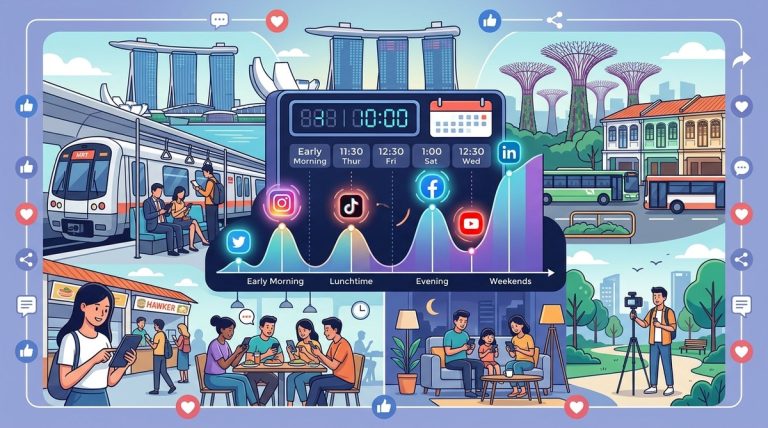
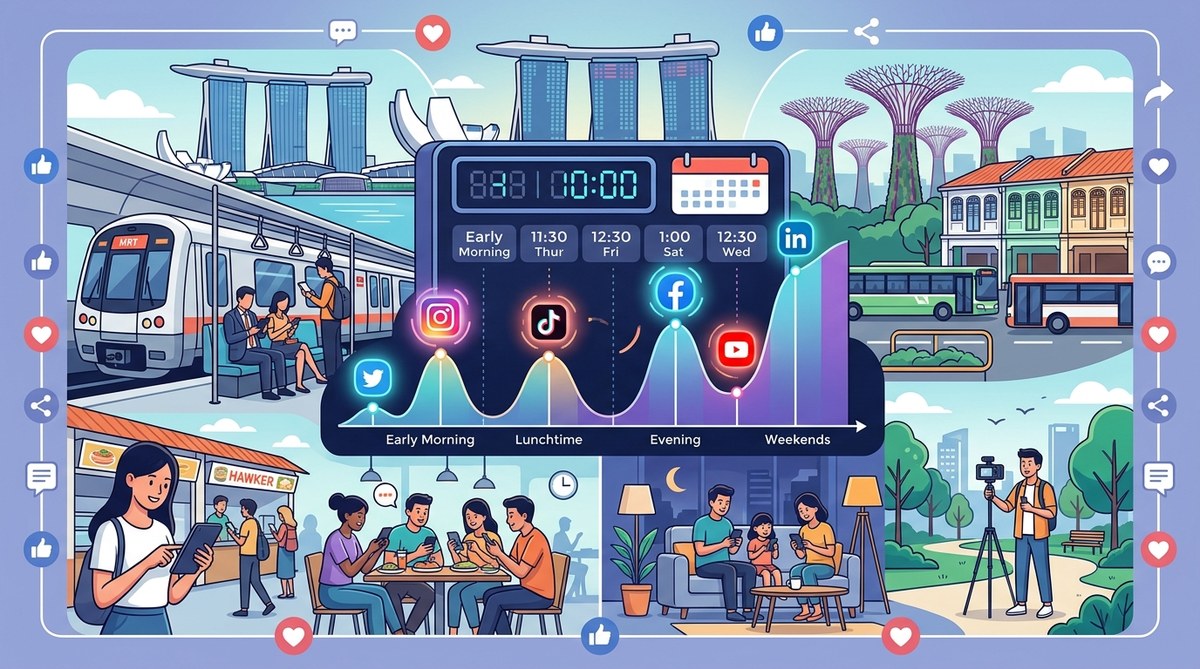
The best times to post on social media for Singapore in 2026 cluster around morning commutes (7am to 9am), lunch breaks (12pm to 1pm), and evening wind-downs (8pm to 10pm). Each platform has its own sweet spot. Instagram Reels perform best at 8pm on weekdays. TikTok thrives at 7am and 9pm. LinkedIn works well at 8am and 12pm on Tuesdays to Thursdays. Facebook still sees strong weekend engagement on Sunday mornings. Test these windows against your own analytics and adjust.
Why your posting time matters more in 2026
Singapore has one of the highest social media penetration rates in the world. With 4.6 million active users, the competition for screen time is intense. Algorithms now prioritise content that gets early traction. If your post goes live while your audience is asleep, it loses that critical first-hour boost. Posting at the right time signals to the algorithm that your content is relevant, which helps it reach more of your followers without paid promotion.
Beyond the algorithm, there is a human factor. Your audience has predictable routines. They scroll during their MRT ride to work, during their lunch break at the hawker centre, and while winding down after dinner. If you align your posts with those natural rhythms, you make it easier for people to engage.
The Singapore daily rhythm and how it affects social media
To understand the best times to post, you need to understand the Singapore day. Here is a rough timeline of when your audience is most active:
- 6am to 7am: Early risers check their phones in bed. This window is small but growing.
- 7am to 9am: The morning commute. This is prime time for TikTok and Instagram Stories.
- 9am to 12pm: Work hours. LinkedIn sees steady activity. Facebook usage dips.
- 12pm to 1pm: Lunch break. A strong window for all platforms, especially Instagram and Facebook.
- 1pm to 6pm: Afternoon slump. Engagement drops. Short-form video can still work.
- 6pm to 8pm: Evening commute. Another peak for TikTok and Instagram.
- 8pm to 10pm: Post-dinner relaxation. The highest engagement window for most platforms.
- 10pm to midnight: Late-night scroll. Good for lifestyle content and TikTok.
These windows are not set in stone, but they form a reliable baseline for 2026.
Platform-by-platform guide for Singapore in 2026
Each social media platform has its own personality. What works on LinkedIn will flop on TikTok. Here is the breakdown for the major platforms.
Instagram in 2026 is all about Reels and Stories. Feed posts still matter, but they have less reach than video content.
- Best days: Monday to Thursday.
- Best times: 8am to 9am, 12pm to 1pm, and 8pm to 10pm.
- Why it works: Morning commuters watch Reels on the train. Lunch breaks are for casual browsing. Evening hours are for deeper engagement.
If you are a lifestyle creator or a local brand, try posting a Reel at 8pm on a Tuesday. That window often catches people who are relaxing after dinner and open to discovering new content.
TikTok
TikTok remains the king of short-form video in Singapore. Its algorithm rewards consistency and early engagement.
- Best days: Tuesday to Friday.
- Best times: 7am to 8am, 12pm to 1pm, and 9pm to 11pm.
- Why it works: The morning window catches commuters. The late evening window catches students and young adults.
TikTok users in Singapore tend to be younger, so the late-night window is especially strong. If your content targets Gen Z, aim for 9pm to 10pm on Thursdays.
Facebook is still relevant in Singapore, especially for older demographics and community groups.
- Best days: Sunday and Wednesday.
- Best times: 9am to 10am and 8pm to 9pm.
- Why it works: Sunday mornings are for catching up on news and family updates. Wednesday evenings are for community engagement.
If you run a local business or a parenting group, Sunday morning posts tend to get the most comments and shares.
LinkedIn has grown steadily in Singapore, especially among professionals and B2B brands.
- Best days: Tuesday, Wednesday, Thursday.
- Best times: 8am to 9am and 12pm to 1pm.
- Why it works: Professionals check LinkedIn during morning coffee and lunch breaks.
Avoid posting on weekends or late evenings. LinkedIn engagement drops sharply outside of business hours.
YouTube
YouTube is a search engine as much as a social platform. Timing matters less for discoverability, but it still affects initial views.
- Best days: Saturday and Sunday.
- Best times: 10am to 12pm and 8pm to 10pm.
- Why it works: Weekends give viewers more time to watch longer content. Evenings are for binge-watching.
If you are a Singapore creator, schedule your uploads for Saturday morning so the algorithm has the whole weekend to test your video.
How to find your personal best time to post
General guidelines are a great starting point, but your own audience may behave differently. Here is a simple process to find your sweet spot.
- Pick one platform to test first. Do not try to optimise everything at once.
- Look at your past 30 days of analytics. Note which posts got the highest engagement and what time they were published.
- Identify three time windows from the general guide above that match your content type.
- Post at those times for two weeks. Keep everything else the same (hashtags, captions, format).
- Compare the results. Which window consistently performed best?
- Repeat the test with smaller time increments. For example, test 8pm versus 9pm.
- Document your findings. Update your content calendar with your personalised schedule.
This method works because it combines industry data with your own audience behaviour. It also helps you spot seasonal shifts, like how engagement changes during school holidays or festive seasons.
Common timing mistakes to avoid
Even with the right data, it is easy to slip into bad habits. Here are the most common mistakes Singapore creators make.
| Mistake | Why it hurts | Better approach |
|---|---|---|
| Posting at the same time every day | You miss different audience segments | Rotate between morning, lunch, and evening windows |
| Ignoring time zone differences | You might be targeting a global audience | Use a scheduling tool that shows your audience’s local time |
| Posting only on weekdays | Weekend engagement is strong for certain niches | Test Saturday and Sunday for lifestyle or hobby content |
| Copying a competitor’s schedule | Their audience may have different habits | Use their schedule as inspiration, then test your own |
| Forgetting about public holidays | Engagement drops on holidays like CNY or Deepavali | Plan around holidays using a content calendar |
How to build a content calendar around your posting times
Once you know your best windows, the next step is to plan your content around them. A good content calendar does not just list dates. It maps each post to a specific time slot.
Start by listing all the platforms you use. For each platform, write down your top two posting windows. Then block those times in your calendar as “publishing slots”. When you create content, batch it so that you always have something ready for those windows.
For example, if you post on Instagram at 8am on Tuesdays and 8pm on Thursdays, prepare two Reels every weekend. Schedule them in advance using a tool like Meta Business Suite or a third-party scheduler. This approach ensures you never miss a slot.
If you need help with strategy, check out this guide on mastering content strategy for Singapore creators in 2026. It covers how to align your posting schedule with your overall content goals.
“The best posting time is the one you can stick to consistently. It is better to post at 8pm every Tuesday than to chase a ‘perfect’ time and burn out.” – Nuffnang content team
When to break the rules
General guidelines are useful, but there are times when you should ignore them. For example, if you are covering a live event like the Singapore Grand Prix or a major sale like 11.11, post in real time. Do not wait for your scheduled window.
Similarly, if you notice a sudden spike in engagement at an unusual hour, pay attention. Your audience might have shifted. Maybe your followers are mostly students who stay up late during exam season. Adjust your schedule accordingly.
The key is to treat these guidelines as a starting point, not a prison. Test, measure, and adapt.
What about weekends and public holidays
Weekends in Singapore have a different rhythm. Many people sleep in, so the morning commute window shifts later. Saturday and Sunday are good for lifestyle, food, and travel content.
- Saturday best times: 10am to 12pm, 8pm to 10pm.
- Sunday best times: 9am to 11am, 8pm to 9pm.
Public holidays like Chinese New Year, Hari Raya, and Deepavali can disrupt regular patterns. During these periods, people spend more time with family and less time on social media. If you do post during a holiday, keep it light and festive. Avoid hard selling.
Tools to help you schedule and track
You do not need to wake up at 7am just to post. Use scheduling tools to automate your publishing. Here are a few that work well for Singapore creators.
- Meta Business Suite: Free and reliable for Instagram and Facebook.
- Later: Good for visual planning and Instagram Reels.
- Hootsuite: Works across multiple platforms.
- Buffer: Simple and clean interface.
These tools also provide analytics. Use them to track which posting times generate the most engagement. Over time, you will build a personalised schedule that outperforms any generic guide.
Putting it all together
Here is a summary table of the best times to post on social media for Singapore in 2026.
| Platform | Best days | Best times (SGT) |
|---|---|---|
| Mon to Thurs | 8am, 12pm, 8pm | |
| TikTok | Tues to Fri | 7am, 12pm, 9pm |
| Sun, Wed | 9am, 8pm | |
| Tues to Thurs | 8am, 12pm | |
| YouTube | Sat, Sun | 10am, 8pm |
Use this as your cheat sheet. Print it out or pin it to your wall. But remember to test each window against your own analytics.
Your next move for 2026
You now have the data and the process to post at the best times for your Singapore audience. The next step is to take action. Pick one platform and one time window from this guide. Commit to posting at that time for two weeks. Track your results. Then adjust.
If you want to go deeper, read about how Singapore content creators can leverage local trends for maximum monetization in 2026. That article shows how to combine timing with trending topics for even better results.
You have everything you need. Start testing today, and watch your engagement grow.
About the Author